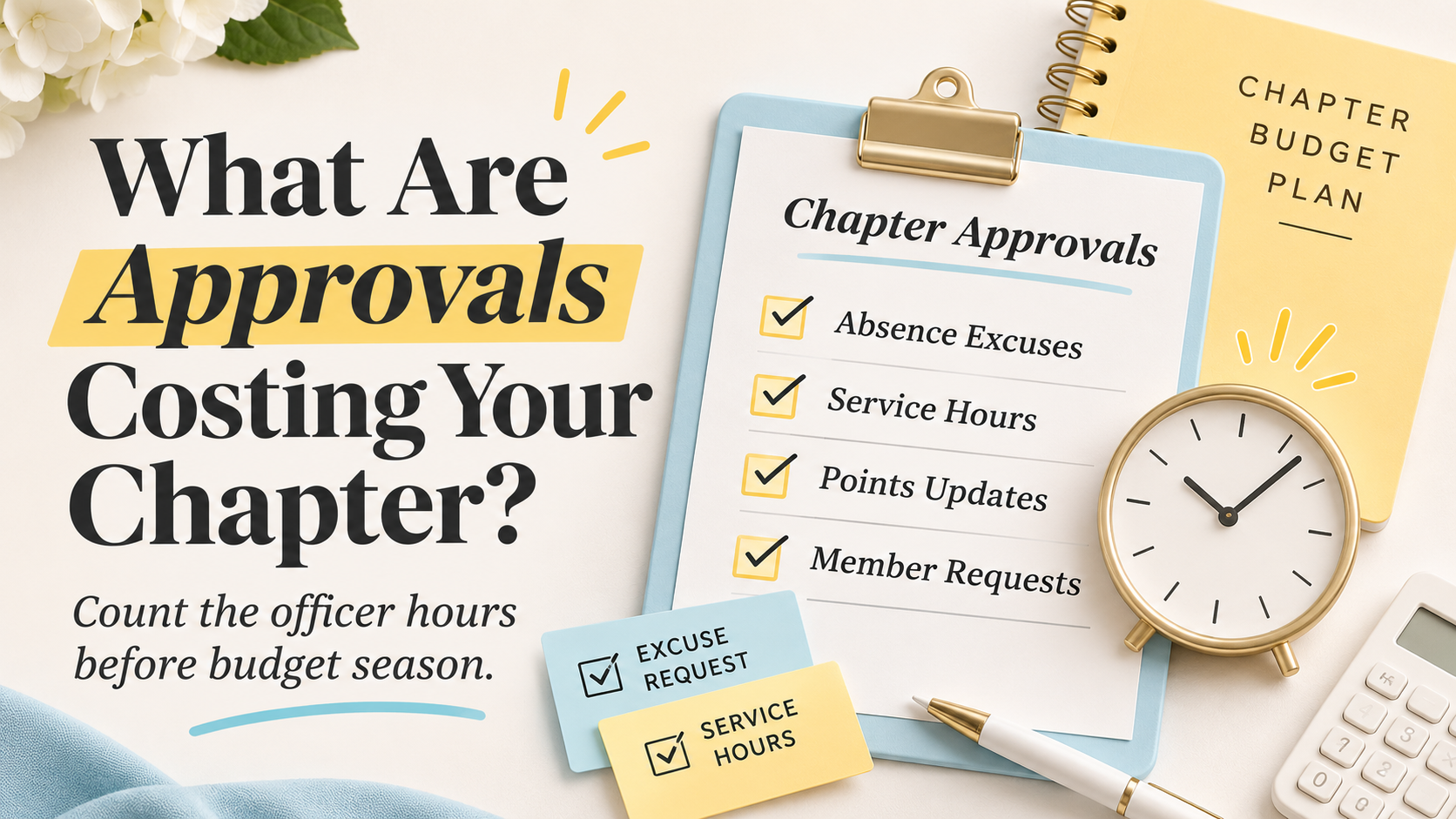
It's Sunday night. You're getting ready for chapter tomorrow, your treasurer is working on next year's budget, and you've just gotten another message asking when someone's excuse will be approved.
You know you saw that submission somewhere. Was it in the form responses? The spreadsheet? That group chat from Tuesday?
And once you find it, you're not necessarily finished. There might be points to update, another officer to loop in, and a member waiting to hear whether their request went through.
None of these tasks is particularly complicated on its own. But when you're handling them week after week, they start taking up a surprising amount of your time.
Here's the thing: Your exec board probably knows how many approvals your chapter processes. But does anyone know how many officer hours those approvals actually take?
Before your chapter finalizes next year's plans, that's a conversation worth having.
Why the Budget Is the Right Time to Talk About Approvals
Budget season naturally gets your exec board thinking about the year ahead. You're reviewing chapter priorities, evaluating what worked, and deciding what needs attention.
It's also a good opportunity to look at the work happening behind the scenes.
Think about how many responsibilities fall under chapter operations. Reviewing excuses, tracking service hours, checking eligibility, answering member questions, and keeping records organized.
These tasks are important. They help your chapter operate fairly and consistently, and they support the expectations your members have agreed to.
But because that work is spread across different officers and committees, it's easy to overlook how much time goes into it.
Your treasurer might see the big picture of chapter planning without realizing that your secretary spends part of every evening responding to approval questions.
That's not anyone's fault. It's just information that rarely makes it into the conversation.
The goal isn't to prove your current process is bad. It's to give your exec board a clearer picture of what running that process requires.
Budget Approval Is a Process, Not One Meeting: Exec, Chapter Vote, Advisor Sign-Off
Depending on your chapter's procedures, annual planning can involve executive board discussions, chapter approval, and advisor review.
That means a proposed operational change may need to make sense to several different audiences.
Your exec board will want to understand the problem and what you're recommending.
Your chapter may need to understand how a change affects members and their responsibilities.
Your advisor may want to know how decisions are documented, who has approval authority, and how your procedures will carry over to the next officer team.
It's much easier to have those conversations when you have actual information instead of saying, "Trust me, we spend forever on this."
And the good news? You don't need an elaborate report.
You just need to start counting.
Step 1: List Your Recurring Approvals
Start by writing down the types of requests your chapter regularly reviews.
Depending on your policies, these might include excuses for missed events, study-hour submissions, service-hour verification, outfit checks during recruitment, guest requests, or standards-related appeals.
You probably know these categories by heart. After all, you're the person everyone messages when they have a question.
But don't assume every approval follows the same process.
For example, your chapter might have one officer reviewing absence excuses while another committee handles appeals. Service hours may require outside verification, while other requests simply need someone to check whether they meet an established requirement.
Those differences matter because they affect how much officer attention each category needs.
Once you have your list, you're ready to look at the work involved in each one.
Step 2: Fill In Your Chapter's Own Numbers
This is where things get interesting.
For each approval category, answer four questions:
1. How many requests come through in a typical month? Use your actual submission history where possible.
2. Who reviews them? Include every officer or committee involved, especially when requests require more than one review.
3. How many minutes does each request take? Think about opening the submission, checking the relevant policy, reviewing supporting information, and recording a decision.
4. Where does the request live today? Maybe you're using forms, spreadsheets, email, group chats, or a combination of tools.
Now, there's another part of this process that's easy to forget.
The actual approval isn't always what takes the most attention. It's everything that happens around it.
Let's say a member submits an excuse for a missed event.
A few days later, she needs to know whether those points will count toward eligibility for an upcoming date party. She hasn't seen an update, so she messages an exec officer.
That officer has to find the original submission, check whether someone reviewed it, and figure out where things stand.
Maybe the excuse was already approved, but the points haven't been updated yet. Or maybe the officer reviewing excuses needs to communicate with whoever maintains the points records.
Now someone has to update the information, potentially in more than one place.
And if the member doesn't know her approval was processed or her points were updated?
Another message.
Congratulations, your approval process has developed a sequel.
This isn't necessarily because anyone is doing something wrong. Forms can collect submissions just fine, and spreadsheets can be useful for tracking records. The challenge comes when the steps between submitting, reviewing, updating records, and communicating decisions depend on several people remembering to follow through. And I got stressed just writing all that.
So when you're calculating officer hours, don't stop at the time spent reviewing submissions.
Ask yourself: How frequently do members follow up on pending approvals? How often do officers answer questions about point balances? Who updates the points after a decision? Does that information need to be entered into multiple records? How does the member find out that something changed?
And importantly, how much time do those additional messages and updates require?
Those minutes are part of your approval process, too.
They're also worth discussing because members spend time following up and checking their records, not just officers.
You don't need to track every message perfectly. Start with a typical month, use your existing records, and make a reasonable estimate where necessary.
The point is to understand the full process rather than counting the initial review and calling it finished.
Step 3: Add It Up Per Month and Per Semester
Now that you've identified the work involved, it's time for some simple math.
For each approval category, calculate:
Requests per month × minutes per request = monthly approval minutes
Divide that result by 60 to convert it to hours.
If multiple officers spend time reviewing the same request, include each person's contribution.
Then account for the additional work you identified in Step 2: answering follow-up messages, checking approval statuses, updating points records, and communicating decisions.
If you've already included that work in your minutes-per-request estimate, don't count it twice.
Add your categories together for an estimated monthly total.
Then multiply that total by the number of active months in your chapter's semester.
You now have an estimate of how many officer hours go toward managing approvals each semester.
And no, this doesn't need to become your new statistics hobby.
A reasonable estimate based on your chapter's experience is enough to start a useful conversation. Just be transparent about what's measured and what's estimated.
Step 4: Write Down Where It Breaks
Hours tell part of the story. Recurring problems tell the rest.
As you're reviewing your chapter's approval process, pay attention to the situations that repeatedly require extra attention.
Maybe points disputes send officers searching through previous decisions. Maybe late excuse submissions require multiple follow-ups. Maybe appeals get passed between officers without a clear next step.
Or perhaps your process works well during the semester, but things become confusing when a new exec board takes over.
For each recurring issue, write down what happens, why it requires additional work, and what might help prevent it.
Some improvements may be as simple as clarifying a deadline, standardizing responses, or documenting who owns each step.
You don't need to redesign your entire approval process to make it easier to manage.
Step 5: Answer the Questions Your Advisor Will Ask
Before you recommend changes, make sure you can explain how the process is supposed to work.
Who has the authority to approve an excuse? Where are the requirements written? What happens when a member disagrees with a decision? Who handles requests that are still pending when officers transition?
These questions matter because your approvals aren't just administrative tasks. They're part of how your chapter applies its policies consistently.
Your advisor may also want to understand how officers document decisions and maintain continuity between executive boards.
If those answers aren't clear today, that's useful information in itself.
Consider creating or updating a simple written procedure that outlines each approval category, its requirements, the responsible officer, and the steps for handling questions or appeals.
It won't eliminate every follow-up, but it gives current and future officers a clearer starting point.
Step 6: Hand Your Treasurer the Officer-Hours Total
Once you've done the calculations, pull your findings into a short summary.
Your treasurer doesn't need a record of every excuse submitted throughout the semester.
They need to understand approximately how much officer time goes toward managing approvals, which responsibilities take the most attention, and where your exec board sees opportunities to improve.
Include your estimated monthly and semester hours, the officers involved, and the recurring challenges you identified.
Then suggest one or two changes worth discussing.
Maybe your chapter needs clearer approval deadlines. Maybe members need a more consistent way to check request statuses. Maybe your current process requires officers to repeat the same updates across different records.
Whatever you recommend, connect it to the work you've documented.
That gives your treasurer useful information to bring into the planning conversation, rather than another vague request to "make things easier."
How to Bring It to Exec (Champion, Then Treasurer, Then President)
You don't need to present your findings to the entire executive board at once.
Start with the officer closest to the process, whether that's your secretary, VP admin, or another chapter leader.
If that's you, congratulations. You've already completed the first step.
Next, bring your findings to your treasurer. Explain the officer-hours estimate, the recurring issues, and what changes you're considering.
Once you've discussed those findings, work with your president to determine what makes sense to bring before exec.
Keep the conversation focused on the chapter's needs rather than the frustrations of any individual officer.
Instead of saying, "Our approval system is a mess," try:
"We looked at how much time we're spending reviewing requests, updating points, and answering follow-up questions. There are a few steps we think we could simplify for next year's officers."
That's a conversation people can actually work with.
And remember, changing your tools isn't always the answer. Sometimes better deadlines, clearer responsibilities, or improved documentation can make a meaningful difference.
The goal is to figure out what your chapter needs before deciding how to address it.
Where Hyve Fits
If your exec board finds that approvals, points, and event participation require a lot of coordination between officers, it may be worth looking at how your chapter manages those responsibilities.
That's where Hyve House comes into the conversation.
Hyve is one way to run approvals, points, event eligibility, and check-in, so the officer doing the admin isn't the bridge between them. Want to see it with your chapter's rules?
You can walk through your existing policies and see whether the platform makes sense for the way your chapter operates.
Book a demo at thehyvehouse.com/book-a-demo
And whether you decide to explore a new tool or improve the process you're already using, start by counting the hours.
Because your exec board should understand the work that goes into keeping chapter operations running.
Those hours represent time your officers are choosing to spend serving their chapter. It's worth making sure that time is being used thoughtfully, so there's more room for the leadership, service, and sisterhood that brought everyone together in the first place.